
Last updated November 24, 2026
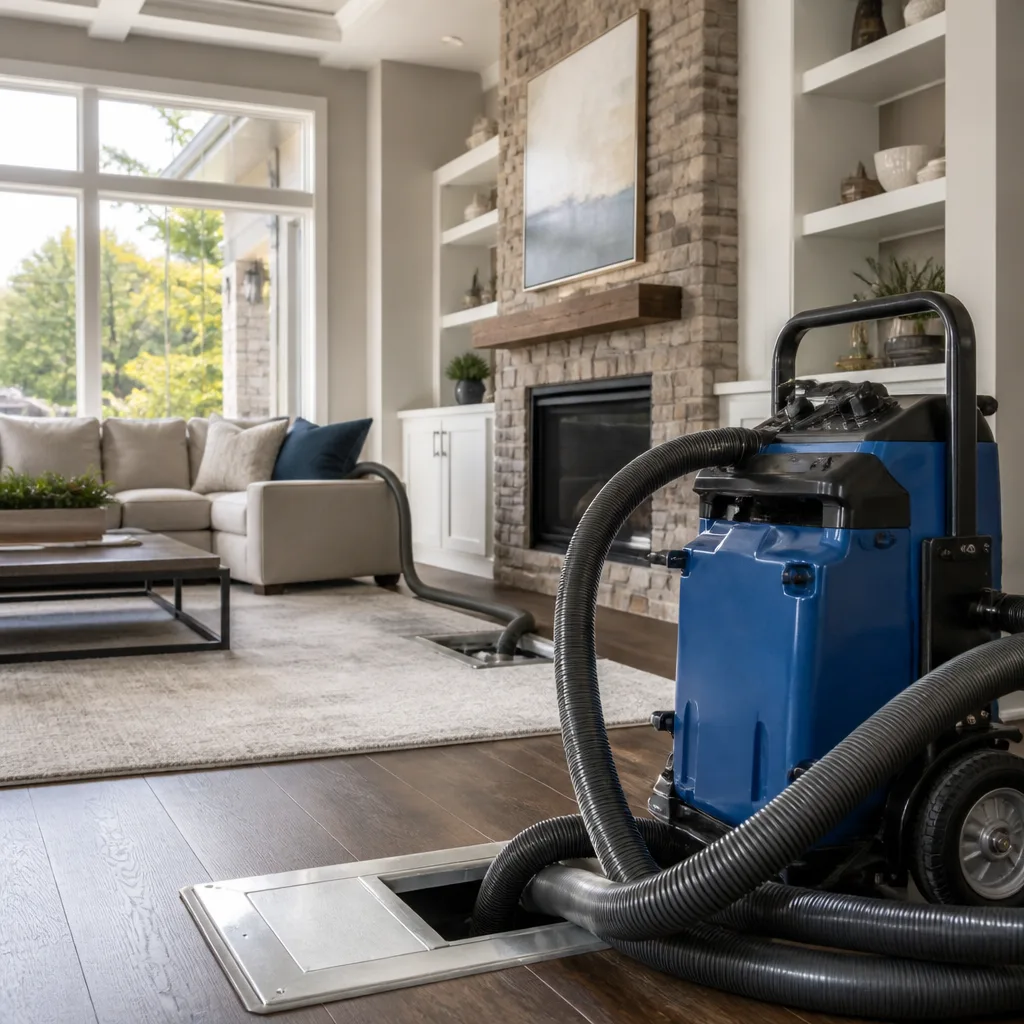 Whole-home duct cleaning
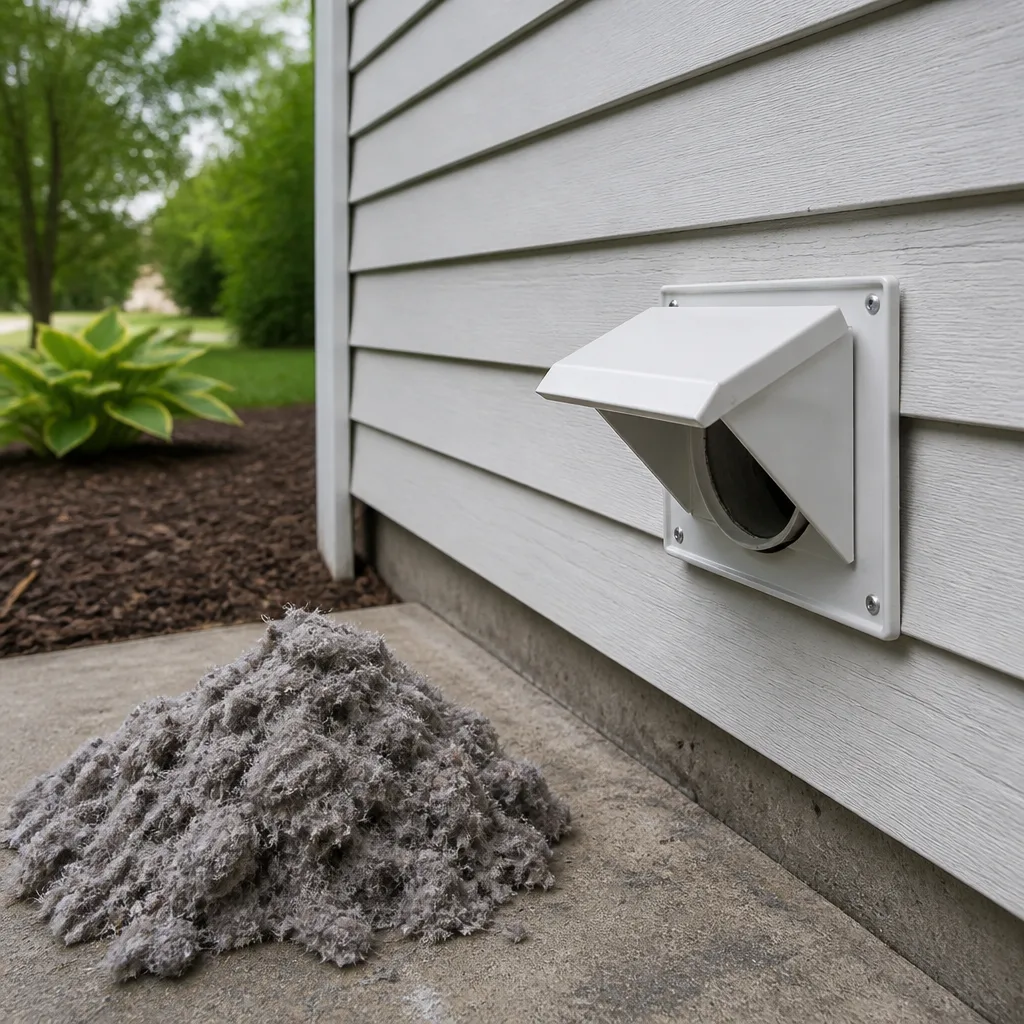 Dryer vent cleaning
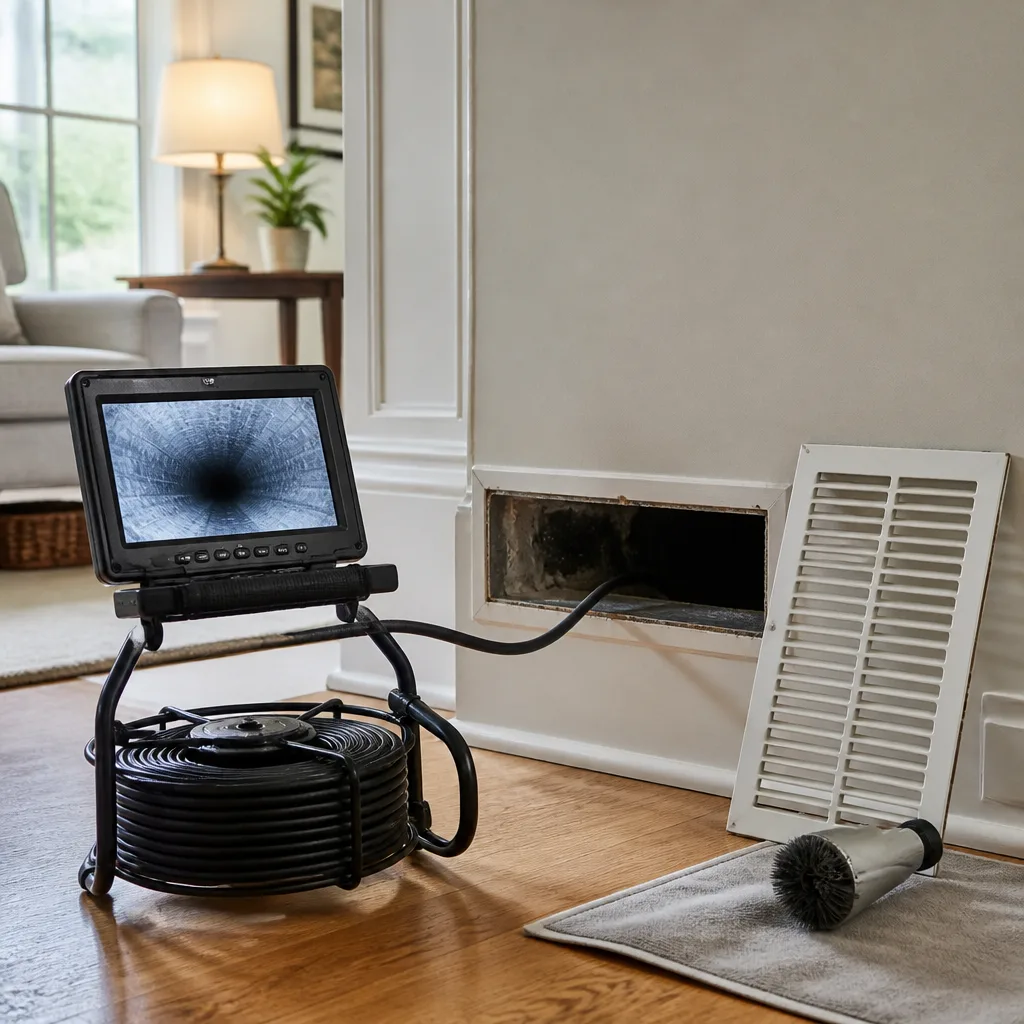 Camera inspection
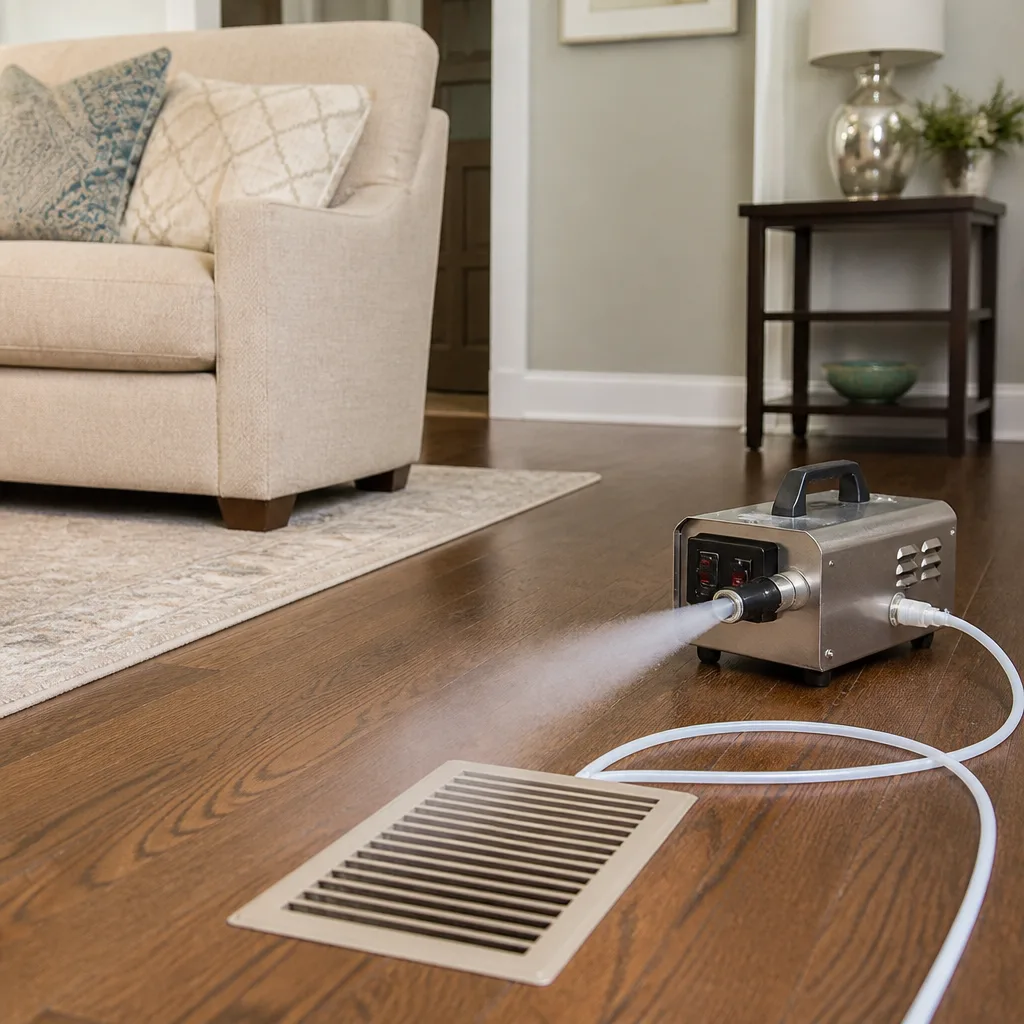 Sanitizing & deodorizing
Whole-system duct and dryer vent check with before-and-after photos - you see exactly what came out of your vents
That "$99 whole-house special" is a bait ad - the real number appears once they are in your hallway, or the "clean" is a shop-vac at the register. We photograph the inside of your ducts before and after instead.
Air Duct Cleaning Troubleshooting in Huntington Beach: Common Problems and How to Fix Them
If your ducts were cleaned six months ago and you’re already seeing dust at the registers, the cleaning didn’t fail. Your diagnosis did. Most of what homeowners in Huntington Beach describe as “duct problems” – dust at the vents, a musty smell in the hallway, a bedroom that never gets enough air – are usually symptoms of a system-level issue, not isolated faults. A dirty section of duct is a symptom. The real question is why it’s dirty, and what else has been going on in the same air system that nobody looked at. This guide is built to help you read those symptoms the way a technician does, before you spend money on the wrong fix.
Quick Answer
Most recurring duct problems in Huntington Beach come down to one of five causes: contaminated duct interiors, leaky or disconnected duct joints, moisture and biological growth, undersized or poorly balanced HVAC equipment, or a cleaning job that didn’t actually address the full system. Before assuming you need another cleaning, check the register dust pattern, the smell, the sound, and the room-to-room airflow. Those four signals will point you to the right fix most of the time.
Styles & brands we work with
- Whole-home duct cleaning
- Dryer vent cleaning
- Camera inspection
- Sanitizing & deodorizing
Table of Contents
- How Do You Read Duct Symptoms Like a Technician?
- Why Is Dust Back at the Registers Within Weeks?
- What Does a Musty Odor in Huntington Beach Ducts Actually Mean?
- How Does Huntington Beach Humidity Affect Ductwork?
- Why Is One Room Always Cold or Stuffy?
- What Are the Signs a Duct Cleaning Was Done Wrong?
- When Is a “Duct Cleaning” Fix Actually a Sealing or HVAC Problem?
- The Symptom-to-Fix Decision Tree
How Do You Read Duct Symptoms Like a Technician?
A technician walks into a home and doesn’t start by opening the air handler. They start by looking at the pattern. Dust on every register in the house is telling you something different from dust at one vent in one bedroom. A smell that shows up when the system kicks on tells you something different from a smell that’s there all day. Airflow that’s weak at every register is different from airflow that’s weak at the two closest to the return.
You can read the same signals without any tools. Here’s what to watch for, starting the next time you walk through your house:
- Dust pattern at the registers: A thin, even dust film on every grille suggests contaminated duct interiors or a filtration issue. One grille with heavier buildup suggests a localized leak pulling from a dusty space like an attic or garage.
- Smell timing: Odor only at startup usually means something is growing or accumulating inside the system between cycles. A continuous odor points to a source in the occupied space, or a supply duct pulling air from an unconditioned space.
- Sound changes: A whistle at one register means a pressure imbalance. A rattle at the air handler means loose internal components. A quiet system that used to be loud, or vice versa, is worth investigating.
- Airflow feel: Hold your hand at each register while the system runs. A consistent difference of “half the air” from one room to another points to a balancing or sizing issue, not a cleaning issue.
- Filter life: If your filter is loading up in half the time it used to, the system is pulling more debris from somewhere it shouldn’t be.
None of this costs anything. What it does is narrow the problem before you commit to any service. When we do an assessment in Huntington Beach, that read is where the whole appointment starts.
Why Is Dust Back at the Registers Within Weeks?
Because in most cases the dust was never only in the ducts. It was in the air handler cabinet, the blower wheel, the evaporator coil, the return plenum, and the supply boots. A cleaning that covers only the duct runs pulls debris loose from the ducts and pushes it into a system where the actual source is still sitting, undrained. Air movement then redistributes that debris right back to the registers within a few weeks.
What a full-system assessment should look at:
- The blower wheel. A caked blower wheel throws dust into the airstream continuously, regardless of how clean the ducts are.
- The evaporator coil. A wet, dirty coil is one of the most common dust sources in a Huntington Beach system, especially during a long cooling season.
- The return plenum and filter grille. Building dust and lint accumulate here faster than in the supply side.
- Duct joints and boots. Any open seam pulls air from a cavity, and cavities in Southern California homes are dusty.
- Filtration. A filter with an incorrect MERV rating for the system, or a filter that’s simply undersized for the return opening, will let fine particulate bypass and recirculate.
If the fix you received was a duct vacuuming only, and the blower wheel and coil were never looked at, you don’t have a cleaning failure. You have an incomplete scope. When we quote air duct cleaning, the assessment includes the air handler condition for exactly this reason.
What Does a Musty Odor in Huntington Beach Ducts Actually Mean?
A musty odor coming from the registers almost always means one thing: there is damp, organic material somewhere in the system, and air is moving across it. In Huntington Beach homes, that source is usually inside the duct lining, on the evaporator coil, or in the condensate pan. It is rarely the duct sheet metal itself, which doesn’t support growth on its own.
The three most common sources we look for:
- Delaminated internal duct liner. Fiberglass acoustic liner inside supply ducts can absorb moisture and stay wet when the system cycles. Once it’s saturated, no amount of surface cleaning fixes it – the liner has to be replaced.
- The evaporator coil and drain pan. Standing water in the pan, or a coil that never fully dries between cycles, becomes a growth surface. A coil cleaning is often the actual fix, not a duct cleaning.
- Return ducts drawing from a damp space. A return that pulls air from a crawlspace, garage, or a wall cavity with a moisture problem introduces the smell into the whole house.
What you can check yourself: look at the drain pan under the air handler. If there’s standing water, or a film on the inside of the pan, that’s a strong signal. Sniff around the air handler closet, not just the registers – if the smell is more intense there, the coil and pan are the source. If the odor persists after a coil cleaning and duct cleaning, the next step is a look at the liner, which takes a technician. Sanitizing the system is often part of the fix on the supply side, using products compatible with the equipment, but sanitizing a wet system without finding the moisture source just buys you a few weeks.
How Does Huntington Beach Humidity Affect Ductwork?
Huntington Beach sits in a marine-influenced climate with mornings that stay cool and damp well into the day, and many homes here run their HVAC less than inland homes do. That combination creates a specific pattern in ductwork that a troubleshooting guide written for a dry inland market will miss. The core problem is that a system which runs less often also dries out less often, and the ducts hold moisture longer between cycles.
What that means in practice:
- Condensation on supply boots. Cool supply air hitting a warm, humid boot can leave condensation on the outside of the boot and, in bad cases, on the inside of a poorly insulated run. That moisture is a growth surface.
- Liner delamination accelerates. Fiberglass acoustic liner absorbs that condensation, loses its bond to the duct wall, and starts to sag. Once it sags, it obstructs airflow and collects dust.
- Biological growth in the return. A return duct that runs through a humid space without a proper vapor barrier is a common growth location in Huntington Beach homes.
- Poorly sealed joints. A leaky joint pulling humid outside air into the system makes everything above worse.
What you can check: run the system on fan-only during a humid morning and feel the outside of the closest supply boot. If it’s sweating, the insulation or the seal is compromised. If you smell a musty odor more strongly during the marine layer mornings than in the afternoon, moisture is involved.
Why Is One Room Always Cold or Stuffy?
Because airflow in a duct system follows the path of least resistance. If a short, wide run serves the living room and a long, narrow, kinked run serves the back bedroom, the bedroom gets whatever’s left over. Changing the register grille doesn’t fix it, and cleaning the ducts doesn’t fix it either. The duct system is doing exactly what its design dictates.
The most common causes of uneven airflow we find in Huntington Beach homes:
- Undersized return. A single small return serving a large system starves every supply register. This is the most common sizing issue in older homes here.
- Crushed or disconnected flex duct. A flex run that’s been pinched during a remodel, or a joint that pulled apart in the attic, drops that room’s airflow to near zero.
- Too many turns or excessive length on one branch. Every bend costs static pressure. A branch with five elbows loses most of its air before it arrives.
- Balancing damper closed or missing. A damper that was closed for a reason and never reopened, or a branch with no damper at all while other rooms are over-supplied.
- Oversized HVAC equipment on an undersized duct system. A newer, larger condenser on the same old ductwork can’t push more air through a fixed-size duct. Static pressure goes up, airflow at the far registers drops, and the blower works harder for less.
What you can check: with the system running, use your hand at each register and note the difference. Then find the air handler and check whether the return grille is roughly the same size as the filter slot. If the filter slot is much larger than the return grille, someone has probably replaced the equipment without upgrading the return, and that’s a design problem. Airflow complaints that cleaning doesn’t solve are almost always static-pressure problems, and that’s a diagnosis rather than a cleaning. When the issue traces back to duct runs, we handle HVAC cleaning and duct repair as one visit, so a fix isn’t left half done.
What Are the Signs a Duct Cleaning Was Done Wrong?
The signs a cleaning didn’t work are specific, and they tend to show up in a predictable order. If you see more than one of these within 60 days of a cleaning, the scope or the method was wrong – not your expectations.
- Persistent odor after cleaning. A properly cleaned system should have no musty smell at the registers. If the smell is unchanged, the source was never found – most often the evaporator coil, drain pan, or duct liner.
- Increased dust within 30 days. A source-contact vacuum with proper HEPA filtration will not redistribute debris into the home. If dust jumped right after the cleaning, the equipment wasn’t contained, or the debris in the air handler was never removed.
- New rattling or whistling that wasn’t there before. A loose register boot, a dislodged turning vane, or a separated flex joint can all happen when someone is moving brush heads through the system.
- Dust streaming from a register while the system runs. That means debris is still loose inside, or the joint is open. Neither is normal after a proper job.
- No before-and-after documentation. A professional cleaning produces photos of the duct interior at the start and the end. If there’s no documentation, you’re relying on trust in a category with a lot of very cheap competition. Ask to see images from inside your own ducts, not stock photos.
- A price that didn’t match the estimate. A cleaning that turns into a much bigger bill once the technician is on site, or that quotes per-vent, is the classic bait-and-switch pattern. A proper quote is a flat price for the full system, agreed before work starts.
When Is a “Duct Cleaning” Fix Actually a Sealing or HVAC Problem?
Whenever the symptom is stable and recurrable: the same room is always warm, the same dust reappears at the same grille, or the system makes the same noise every cycle. Cleaning changes a variable. If the symptom resets to the same state every time, the variable wasn’t the problem.
The four problems most often mislabeled as “dirty ducts”:
- Leaky duct joints and disconnected boots. The fix is sealing, not cleaning. Leaks pull attic or cavity air into the supply, which is dirtier than the ducts themselves. In Huntington Beach, sealing is where most of the energy loss actually sits in older homes – the conditioning cost is going into an unconditioned space. The fix is mastic or a compatible duct sealant on the accessible joints, and a check from the plenum through to the boots.
- Missing or degraded duct insulation. A duct run that’s lost its insulation sweats, condenses, and eventually grows. The fix is re-insulating the run, not cleaning it. A cleaning without re-insulation will return to the same state within a season.
- Undersized or oversized HVAC equipment. The fix is a sizing review, not a cleaning. This is a design issue, and it explains most unresolved “my ducts are dirty” complaints in homes where the equipment was replaced without a duct review.
- Inadequate filtration. A filter that’s too restrictive for the blower, or too weak for the return, will let everything you clean come right back. Filtration and the duct system are one decision, not two.
When we diagnose a system in Huntington Beach, our technicians use Rotobrush and Nikro equipment for the cleaning side, and Honeywell and Aprilaire products for filtration upgrades where the return is set up for it. The cleaning and the filtration decision happen in the same visit, because doing them separately is how the same dust comes back.
The Symptom-to-Fix Decision Tree
Here’s the decision tree we walk through on a first visit, written so you can apply it yourself. Each step is: what you’re seeing, what’s most likely causing it, what you can check, and when to call.
- Symptom: even dust film on every register. Likely cause: general duct contamination or a filtration failure. DIY check: check the filter condition, then look at the return grille dust pattern. When to call: if dust returns within 30 days of changing the filter, or if you can’t see contamination in the ducts yourself.
- Symptom: heavy dust at one register only. Likely cause: a leak in that branch, or a return pulling from a dusty space. DIY check: look for a separated joint near that boot, if accessible. When to call: if the joint is in an attic, crawlspace, or wall.
- Symptom: musty smell that’s worse when the system kicks on. Likely cause: wet liner, coil, or drain pan. DIY check: look at the drain pan for standing water. When to call: if there’s water, or the smell doesn’t fade after a coil cleaning.
- Symptom: condensation on a supply boot. Likely cause: lost insulation or an unsealed joint pulling humid air. DIY check: feel the boot during a humid morning. When to call: any visible moisture on or around the ductwork.
- Symptom: one room chronically warm or cold. Likely cause: undersized branch, closed damper, or crushed flex. DIY check: feel airflow at every register. When to call: if the room’s airflow is consistently less than half the nearest register.
- Symptom: high energy bill with no equipment change. Likely cause: leaky supply or return ducts. DIY check: feel for air moving around accessible joints. When to call: any leak you can feel or see.
- Symptom: filter loading much faster than before. Likely cause: contamination in the return side or a leak pulling from a dusty space. DIY check: note how many weeks a filter lasts now vs. before. When to call: if the interval has halved.
- Symptom: dryer taking longer to dry. Likely cause: clogged dryer vent. DIY check: feel the outside vent flap while the dryer runs – weak or no airflow means a blockage. When to call: immediately. This is a fire-risk category, and it’s why dryer vent cleaning is a standalone service for us, not an add-on.
See the difference
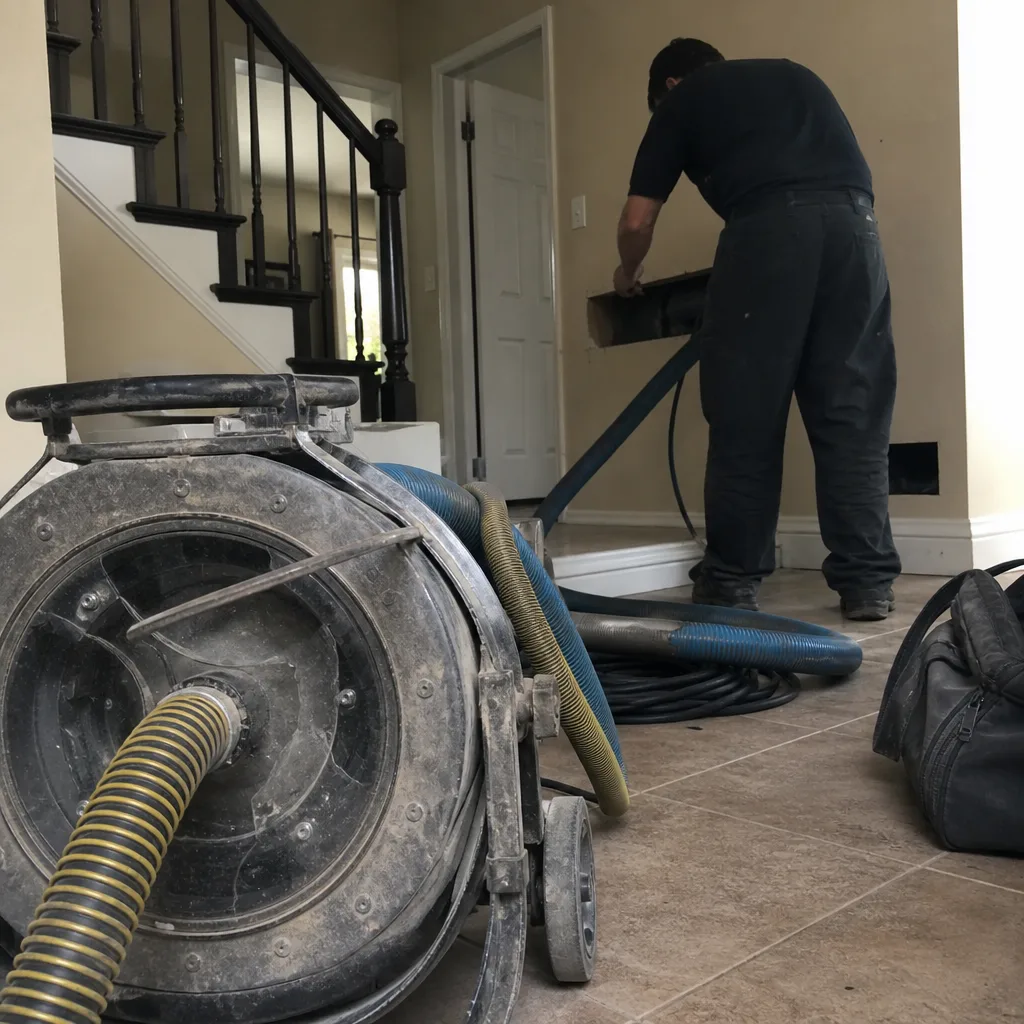 Before
 After
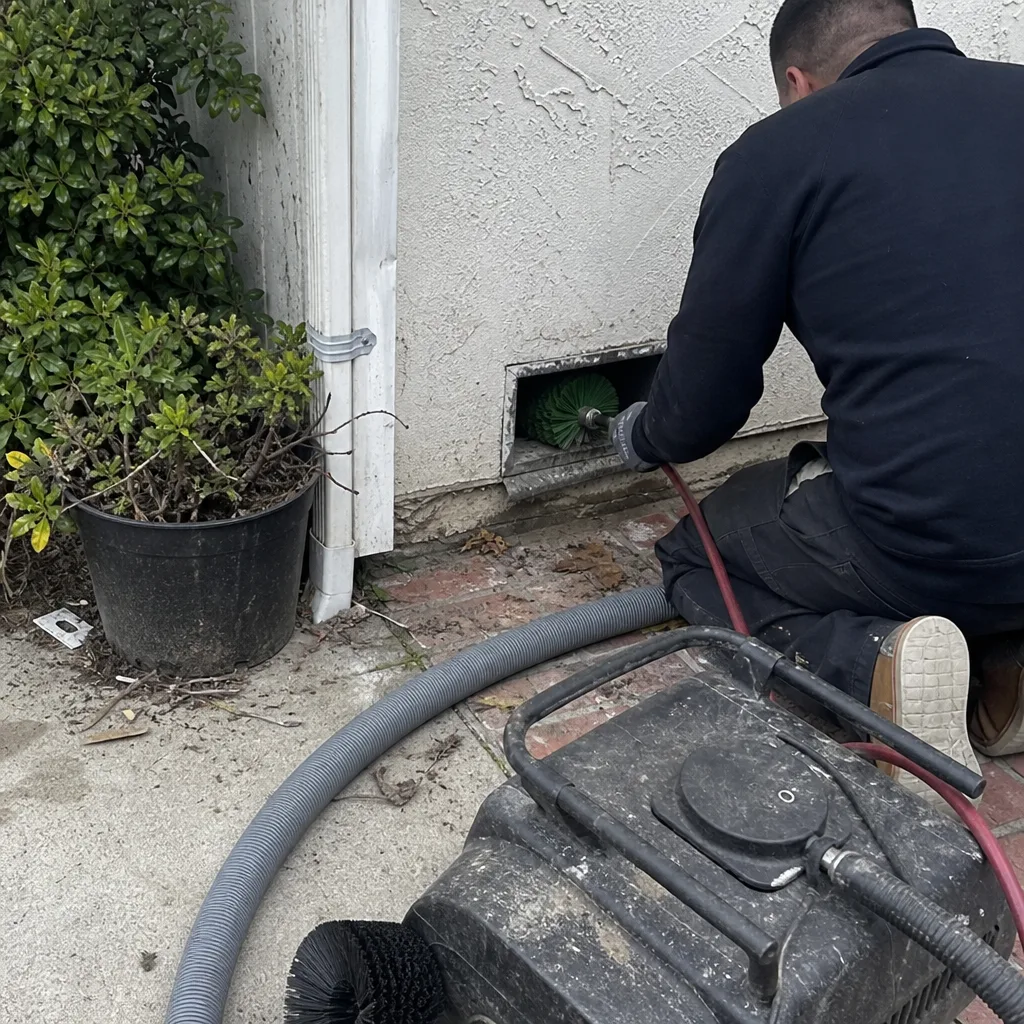 Before
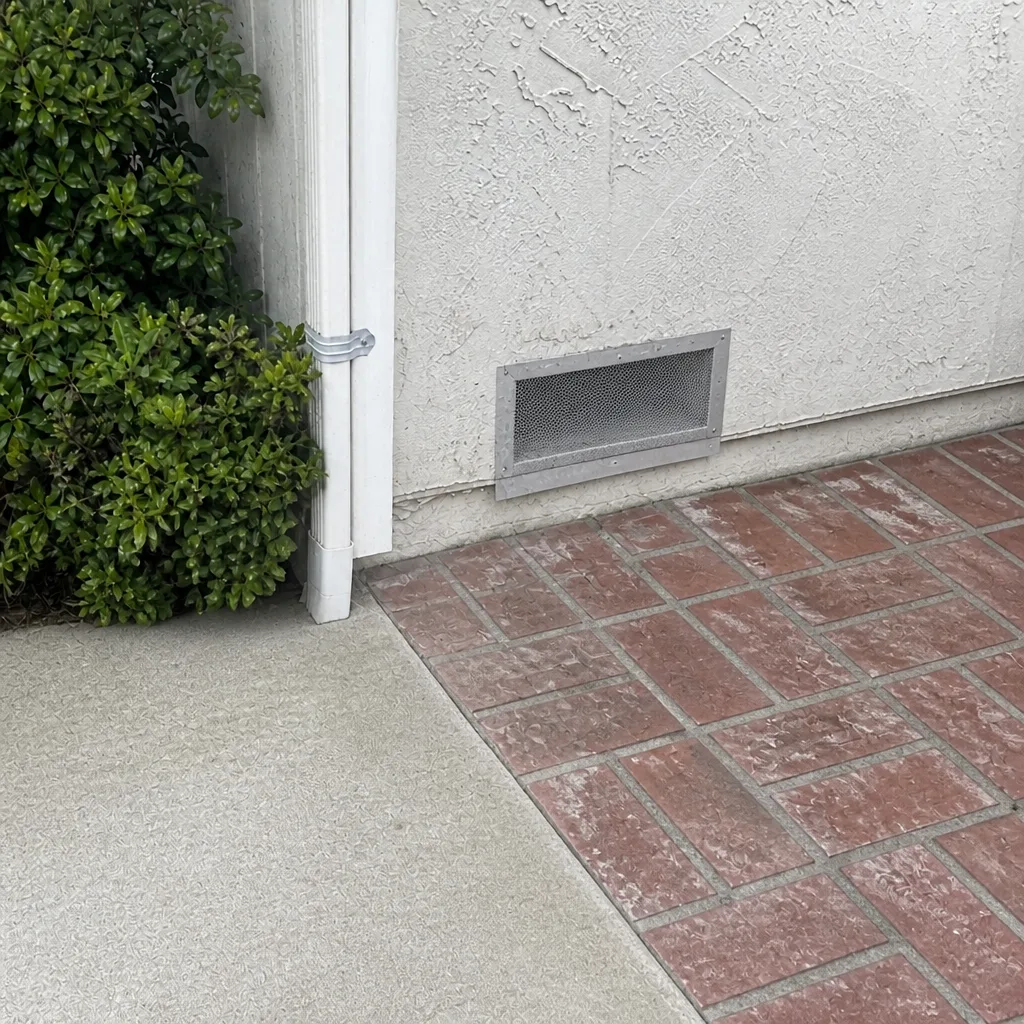 After
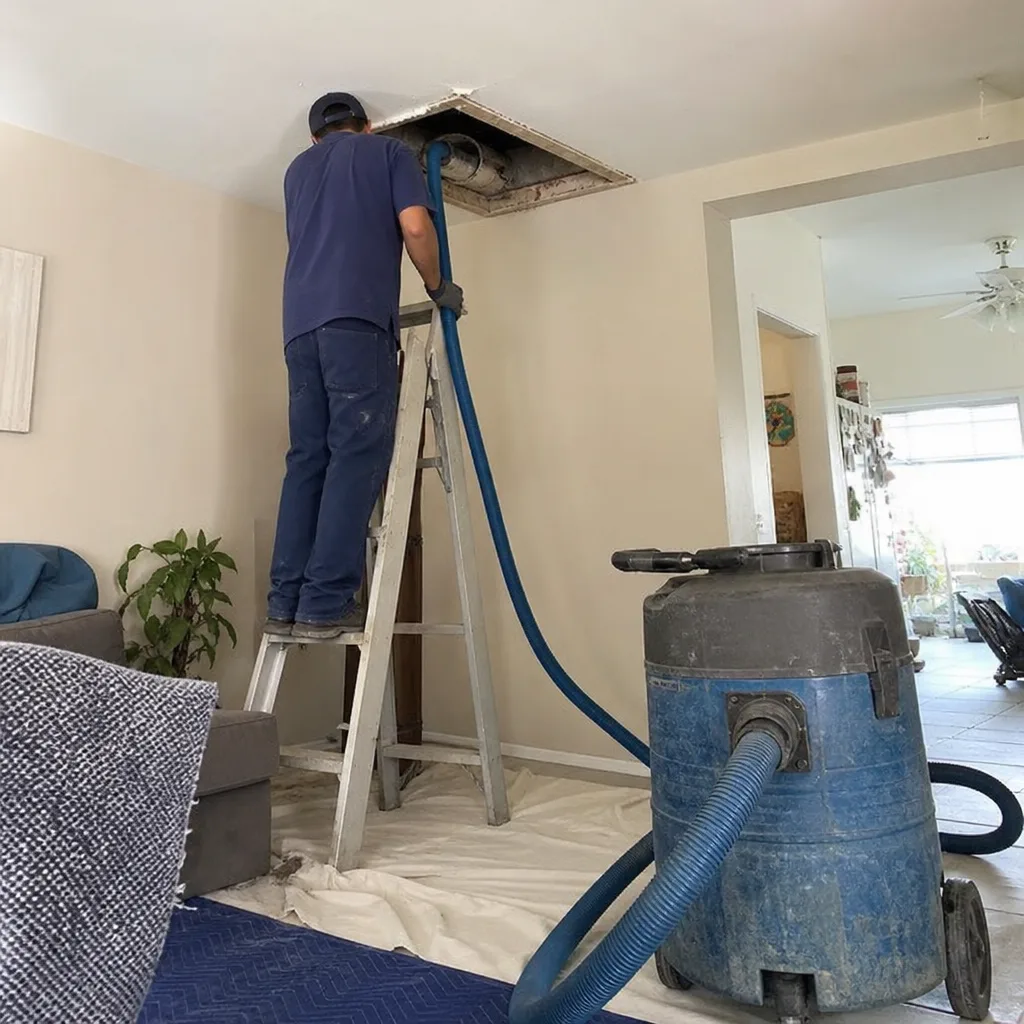 Before
 After
Common Mistakes to Avoid
- Assuming the cleaning failed because dust came back. In a Huntington Beach home where the blower wheel and coil were never touched, the dust that returns in 30 days is the same dust that was never removed. The scope was incomplete, not the cleaning.
- Chasing a coupon price, then paying for a second visit. A very low coupon price usually covers a surface vacuum of the accessible duct only. When the smell and the dust persist, the second visit costs more than the original quote would have. Ask what’s included before you book.
- Ignoring the evaporator coil. Cleaning the ducts without looking at the coil is cleaning the pipeline while the source stays in place. Any estimate that doesn’t include the air handler condition for the assessment is incomplete.
- Treating a musty smell with sanitizer alone. Sanitizing without finding the moisture source just resets the clock. In this climate, the source is usually the liner, the coil, or a humid return.
- Replacing the HVAC equipment without a duct review. A larger system on the same ductwork raises static pressure and can make an existing airflow problem worse. Duct review before equipment replacement, not after.
- Confusing “hot” with “not enough air.” A warm room often has an airflow or insulation problem, not a cooling problem. Feeling the register will tell you which one you’re dealing with.
- Treating dryer vent cleaning as optional. A clogged dryer vent is a fire-risk category, not a comfort issue. It doesn’t fix itself, and a lint screen doesn’t catch what’s already in the duct.
When to Call a Professional
Call a professional when the symptom is stable and recurrable, when the fix involves anything inside an attic, crawlspace, or wall, when the suspect location is the evaporator coil or the blower, or when you can feel air leaking from ductwork. Also call for any of the following: a musty smell that survives a coil cleaning, condensation on a supply boot, a filter that’s loading in half the time it used to, or a dryer vent with weak exterior airflow. Those are all conditions where the diagnosis drives the fix, and a full-system specialist will save you a second visit. Huntington Beach Air Duct Cleaning Co offers free estimates in Huntington Beach – call (855) 658-4076. Our technicians have up to 13 years of experience with full-system diagnosis, and every quote is a flat price for the system agreed before work starts.
Frequently Asked Questions
You need cleaning if you can see debris or growth in the ducts, if dust returns to the registers within 30 days of a filter change, or if the system shows signs of contamination in the return side. If the dust is stable and the smell is gone, you probably don’t. The most reliable test is a visual inspection of a return and a supply run, which a technician can do in the assessment. Call (855) 658-4076 for a free estimate.
Because the source was almost certainly not in the ducts alone. The blower wheel, evaporator coil, drain pan, and return plenum are usually where the volume of debris is sitting. A cleaning that doesn’t include those components redistributes debris back to the registers within weeks. A full-system scope with before-and-after photos of your own ducts is how you verify the job was actually done. Call (855) 658-4076 for an exact quote – estimates are free.
Because a very low quote usually covers less work: the accessible duct runs only, no air handler, no documentation, and equipment that moves less air than a professional system. The cheap quote is often correct for what it covers. It’s just not the same job as a full-system cleaning, and the difference shows up when dust returns within a season. Ask what’s included, and ask for before-and-after photos of your own ducts. Call (855) 658-4076 for an exact quote.
You look at the photos from inside your own ducts at the start of the job and at the end. A professional cleaning produces both. You also look at the register dust pattern and the smell in the first 30 days. If dust settles in normally and there’s no odor at the registers, the job was done. If the same pattern resets immediately, something was missed. Call (855) 658-4076 for a free estimate.
For most homes here, every 3 to 5 years, or sooner if you’ve had a renovation, a moisture event, or a pet change that increased indoor debris load. A home with a properly maintained filtration system can go longer. A home with an unresolved moisture problem needs the moisture fixed before the schedule matters. The system condition, not the calendar, drives the decision. Call (855) 658-4076 for an exact quote.
It’s a moisture problem that shows up as a smell, and cleaning without fixing the moisture will just reset the clock. The three common sources in Huntington Beach are delaminated duct liner, a wet evaporator coil or drain pan, and a return pulling air from a humid space. Fix the moisture first, then clean. Call (855) 658-4076 for a free estimate.
Only for accessible, low-risk joints you can see and reach safely, and only with a compatible sealant. Ductwork in attics, crawlspaces, and walls is a different matter: any leak you can feel in those spaces is worth a professional visit, because the fix is often a joint repair that has to be done correctly the first time. Call (855) 658-4076 for a free estimate.
Key Takeaways
- Recurring duct symptoms are system-level problems, not isolated faults.
- Dust coming back within 30 days usually signals an incomplete scope, not a failed cleaning.
- Musty smells point to moisture – the liner, coil, or drain pan – not the ducts alone.
- Huntington Beach’s marine humidity makes condensation and liner delamination a specific local risk.
- Uneven airflow is a design, sizing, or sealing problem, not a cleaning problem.
- Document the work with photos of your own ducts, before and after.
- Dryer vent cleaning is a fire-risk category, not an optional add-on.
- A flat price for the full system, agreed in writing before work starts, is the standard to hold every quote to.
The Bottom Line
Most of the duct complaints we hear in Huntington Beach come down to one thing: the fix was aimed at the symptom, not the system. Before you book another cleaning, read your registers for the dust pattern, your smell for the timing, your rooms for the airflow, and your filter for the load interval. Those four signals will tell you whether the problem is contamination, sealing, insulation, airflow, or moisture. That read is what a technician does first, and it’s what saves you from paying twice. If the read points to a full-system fix, call us. We use Rotobrush and Nikro equipment for the cleaning, Honeywell and Aprilaire for filtration, and we diagnose the whole system in one visit so a fix isn’t left half done. If the dryer is part of the concern, we handle that in the same call. Clean ducts, sealed ducts, safe ducts. Call (855) 658-4076. We answer 24/7. Fast dispatch from 7am to 7pm, Sunday through Friday.
Written by the team at Huntington Beach Air Duct Cleaning Co.