
Last updated November 24, 2026
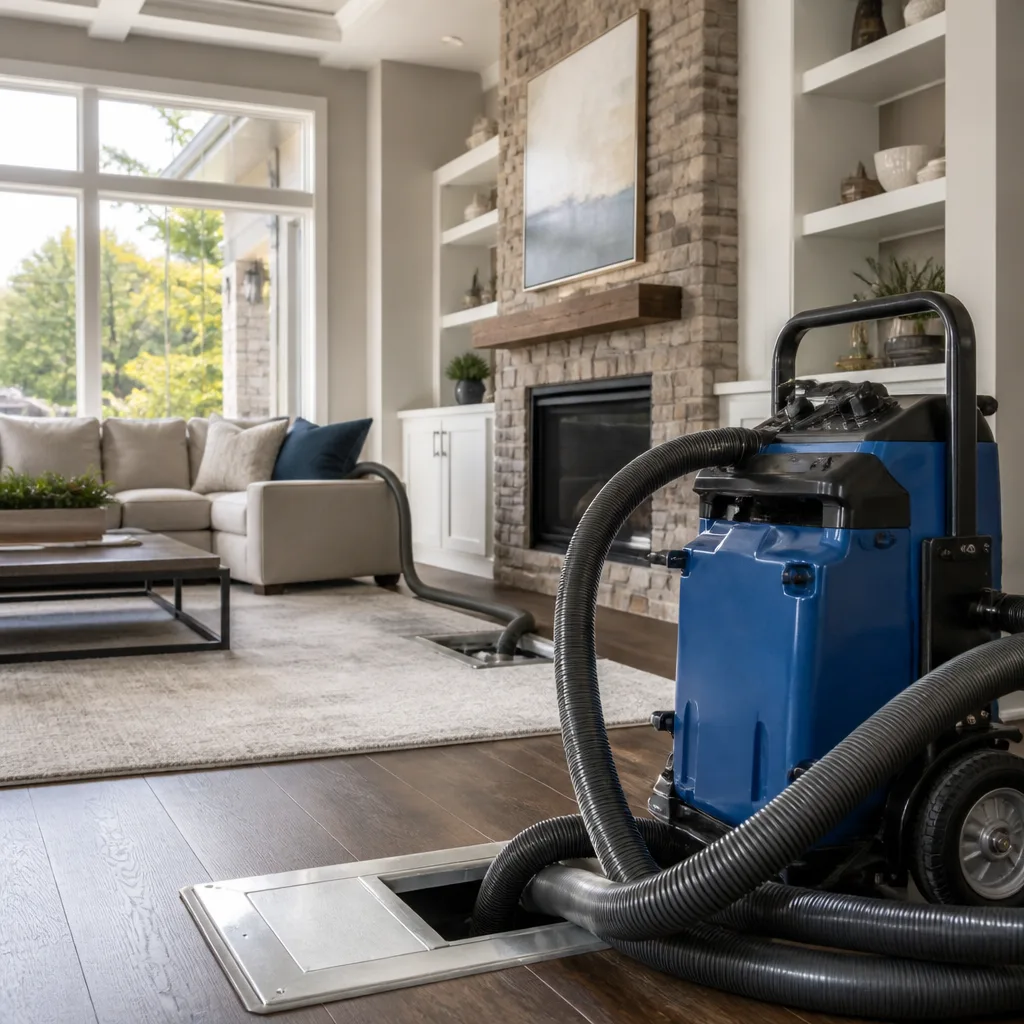 Whole-home duct cleaning
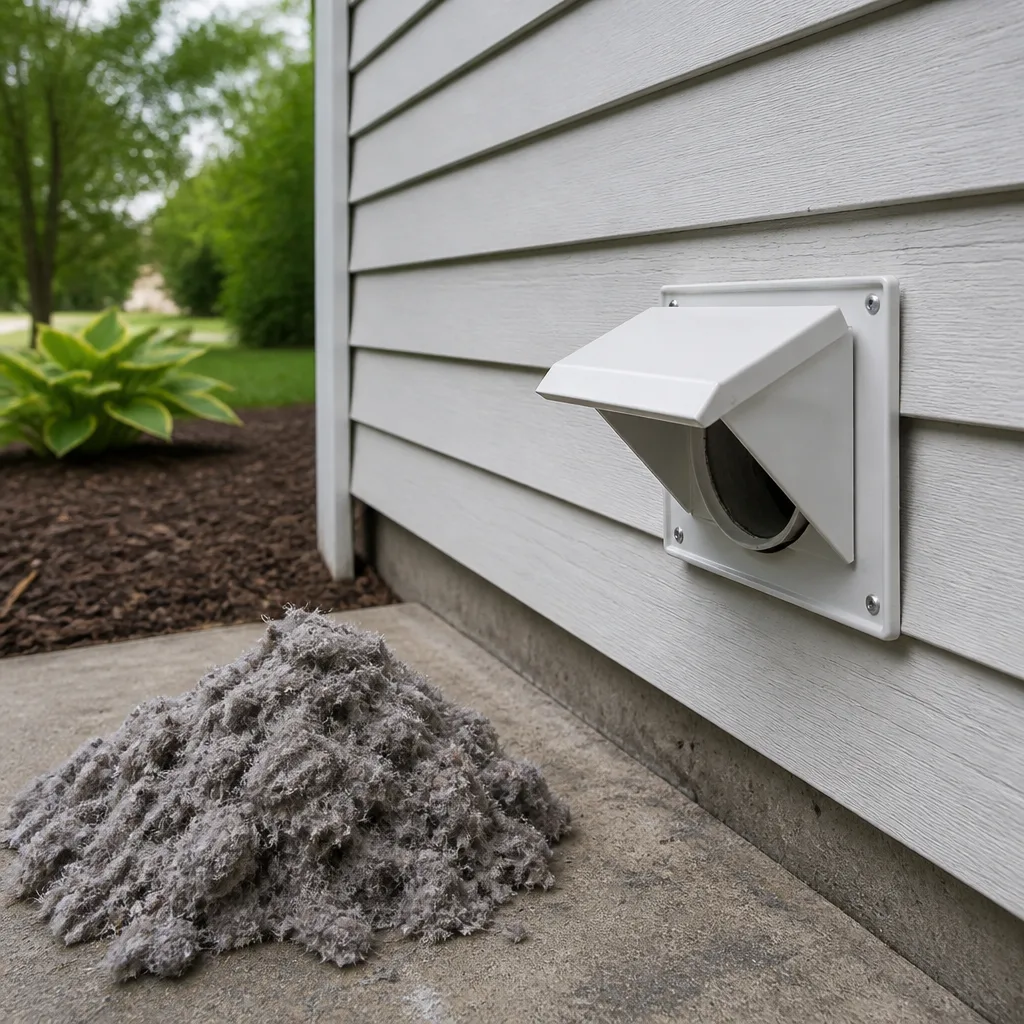 Dryer vent cleaning
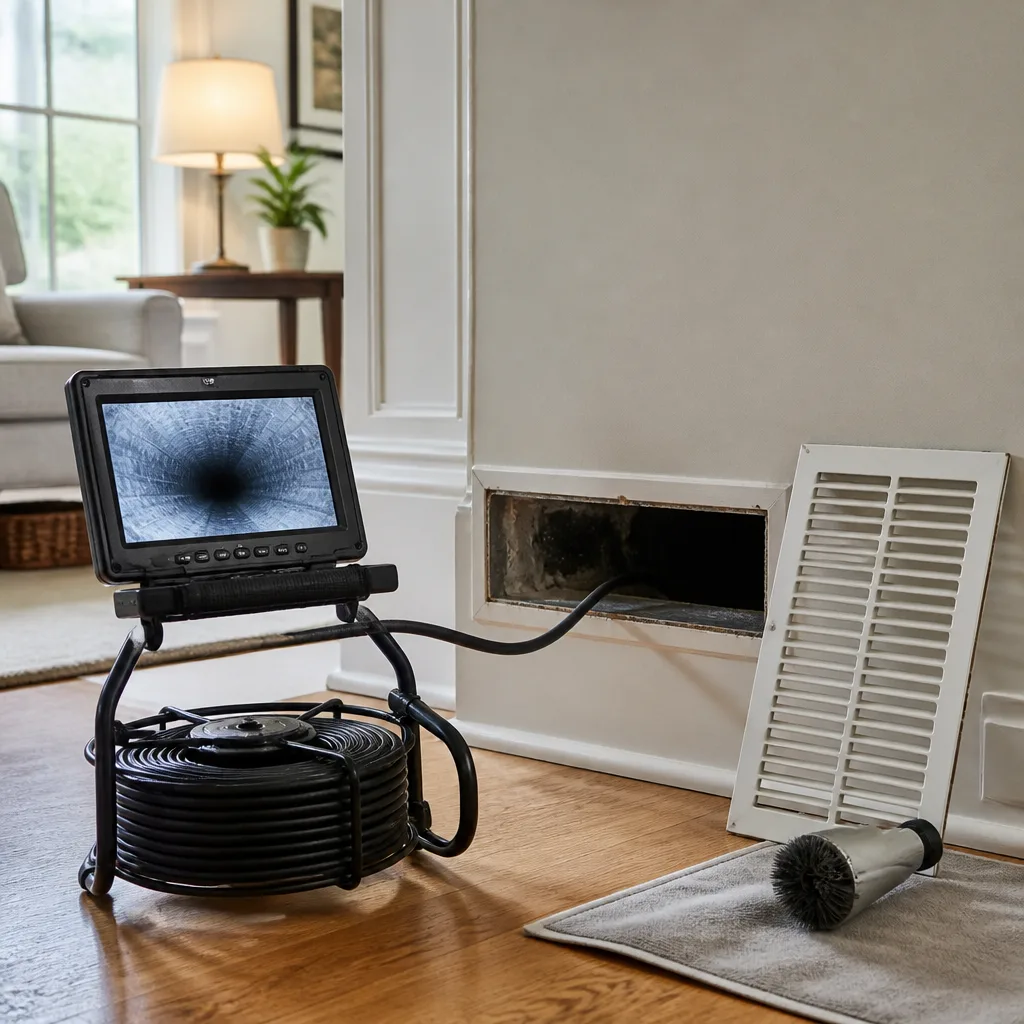 Camera inspection
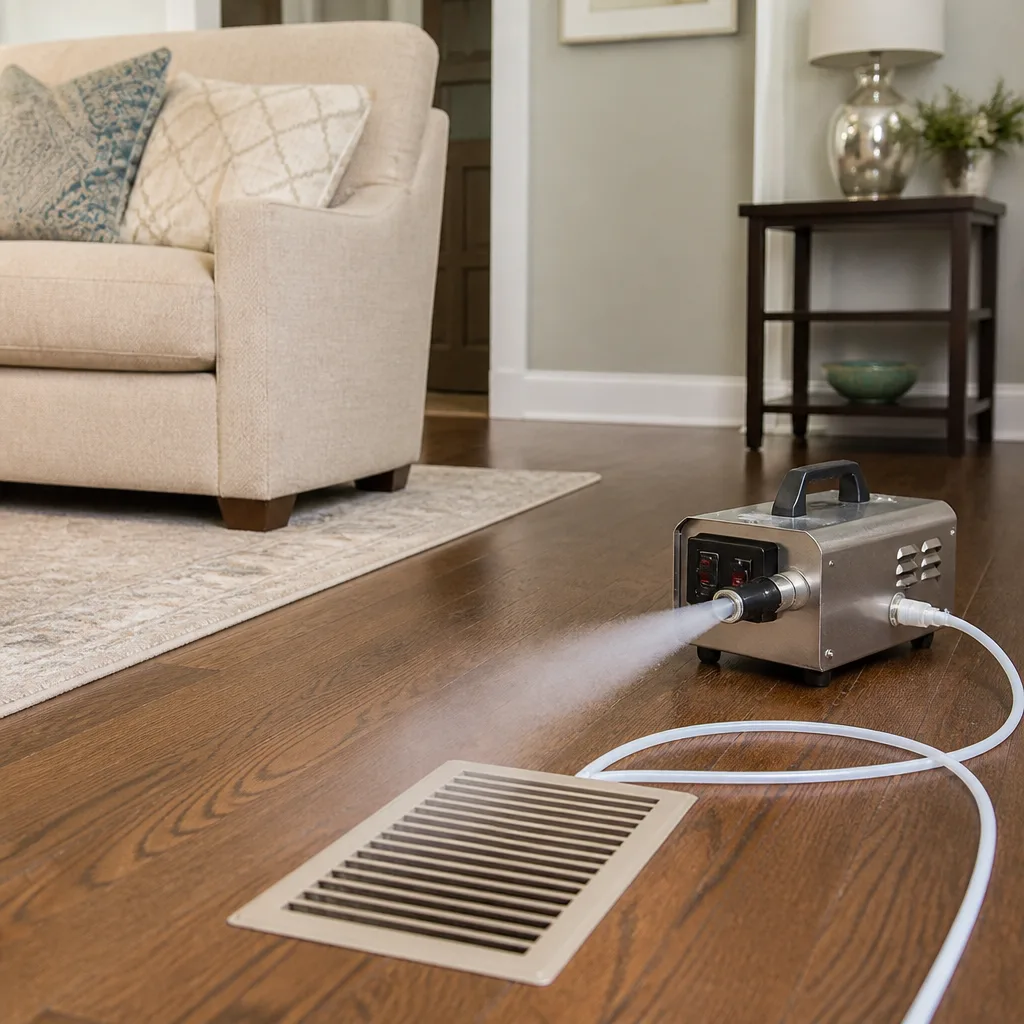 Sanitizing & deodorizing
Whole-system duct and dryer vent check with before-and-after photos - you see exactly what came out of your vents
That "$99 whole-house special" is a bait ad - the real number appears once they are in your hallway, or the "clean" is a shop-vac at the register. We photograph the inside of your ducts before and after instead.
DIY vs Professional Air Duct Cleaning: The Huntington Beach Homeowner’s Decision Guide
Here’s the part most DIY duct cleaning advice skips: a shop-vac moves roughly 150 cubic feet of air per minute. A truck-mounted negative-air machine moves 4,000 to 6,000. That gap isn’t a marketing number, it’s the whole physics of the job. Pull a shop-vac hose into a supply register and you’re not extracting the dust packed along that run. You’re stirring the first foot of it and pushing the rest deeper into the system, where it settles in the joints and turns up at the registers again a week later. This guide walks through what actually happens inside your ductwork, what you can safely do yourself, and where DIY stops making sense in Huntington Beach homes.
Quick Answer
DIY air duct cleaning is only worth doing for surface-level maintenance: swapping filters, vacuuming register grilles, and clearing dryer vent lint you can reach. Full duct cleaning needs negative pressure strong enough to pull debris out of the system instead of pushing it around, and a shop-vac can’t generate that. In our experience working on Huntington Beach homes, professionally cleaned ducts are usually the better call once a system has more than a few years of dust buildup. Our technicians have up to 13 years of experience with the equipment this job actually requires.
Styles & brands we work with
- Whole-home duct cleaning
- Dryer vent cleaning
- Camera inspection
- Sanitizing & deodorizing
Table of Contents
- The Physics of Duct Cleaning: Why Airflow Beats Suction
- What Homeowners Can Legitimately Do Themselves
- What Goes Wrong With DIY Attempts in Huntington Beach Ductwork
- Is Professional Air Duct Cleaning Worth It in Huntington Beach?
- How to Tell Whether a Contractor Brings Real Equipment
- What a Proper Professional Cleaning Actually Involves
- Dryer Vents: Where DIY Really Falls Short
The Physics of Duct Cleaning: Why Airflow Beats Suction
Duct cleaning works on a principle that’s closer to a wind tunnel than a vacuum cleaner. Debris in a duct sits in a boundary layer hugging the metal or flex liner. To move it, you need two things working together: mechanical agitation to knock it loose, and enough negative pressure at the collection point to carry it out before it settles again. Suction proximity alone doesn’t do it. A nozzle sitting two inches from a dust deposit won’t lift what’s welded to the duct wall by years of condensation and skin oils.
That’s where airflow velocity comes in. A Rotobrush whip or air-driven cleaning head scours the duct wall, and the high-volume negative pressure generated by professional equipment pulls the loosened material toward the machine. If the pressure isn’t high enough, the debris doesn’t have a directional current to follow; it just billows and lands somewhere else in the run. This is the failure mode of most DIY attempts, and it’s why a system can look cleaner at the register while the problem migrates deeper.
In Huntington Beach, this matters because the housing stock runs from mid-century single-story homes to newer builds, and both have ductwork that wasn’t designed for a homeowner pushing a shop-vac into it. Older homes often have flex runs with unsealed joints or fiberglass-lined trunk lines, where low-velocity agitation does more redistributing than extracting. Newer homes have longer runs with more turns, which is exactly where a shop-vac’s pressure drops to almost nothing.
The practical upshot: if you’re standing at a register with a shop-vac and wondering whether you’re making progress, the answer depends on whether the debris is leaving the system. Feeling airflow at the other end tells you nothing about where the dust went.
What Homeowners Can Legitimately Do Themselves
Not everything about duct maintenance is a professional job, and pretending otherwise wastes your money. There’s a real list of maintenance tasks a homeowner can do safely, and knowing which is which is most of the decision.
Tasks you can handle yourself:
- Filter replacement or cleaning. Change a standard filter every one to three months depending on whether you have pets or run the system constantly. A clogged filter restricts airflow and stresses the blower. If you’ve upgraded to a higher-MERV product or a media cabinet from a filtration brand, follow that manufacturer’s interval rather than guessing.
- Register and grille cleaning. Remove the supply and return grilles, wash them in soapy water, and vacuum the visible dust from the boot behind the plate. This is the highest-value DIY maintenance you can do because grilles catch a surprising amount of debris before it enters the duct.
- Visual inspection. Look into accessible registers and returns with a flashlight. If you see dust coating the duct walls, dark streaks, or anything that looks like moisture damage or liner tearing, that’s information worth having before you call anyone.
- Coil and drain pan checks. Keep the condensate pan dry and clear, and vacuum visible lint from the accessible exterior of the evaporator coil area. Don’t dig into the coil fins themselves.
- Dryer vent lint removal from the accessible ends. Cleaning lint from the back of the dryer and at the exterior vent termination is a genuine safety task. Clearing the full-length run is a different story.
What this list has in common: all of it is surface-level and non-invasive. None of it requires reaching into a sealed duct run or generating pressure. That’s the line. Once you’re thinking about cleaning the actual inside of the ductwork, the question shifts from maintenance to extraction, and extraction is an equipment problem.
For property managers running multiple units, the DIY maintenance list above is worth standardizing. Filter changes and register cleaning on a set schedule cut down on complaints and extend the interval between professional cleanings.
What Goes Wrong With DIY Attempts in Huntington Beach Ductwork
The failure modes of DIY duct cleaning aren’t theoretical. They fall into a few predictable categories, and Huntington Beach’s common duct types make several of them more likely than they’d be in a newer, more uniform housing market.
Flex duct puncture and collapse
Flexible duct is a plastic membrane over a wire helix. It’s tough enough for normal airflow but not for a shop-vac wand or a pushy brush jammed into it. A puncture creates a permanent leak that dumps conditioned air into a wall cavity or crawlspace, and a collapsed section kills airflow to any register downstream of it. You may not notice until a room stops cooling.
Fiberglass liner disturbance
Some duct systems have interior fiberglass acoustic or thermal lining. That lining is delicate. Agitate it with a rigid tool and you can break down the fibers, releasing particles into the airstream that then exit at every register in the house. A homeowner trying to be thorough is more likely to do this than one who leaves it alone, which is an uncomfortable irony. A professional with the right heads and controlled pressure avoids it.
Moisture driven into inaccessible runs
Some DIY cleaning advice recommends damp cloths or light misting to control dust. In a duct system, moisture is the wrong tool. Any water that gets into an inaccessible run becomes a growth environment, and Huntington Beach’s mild winters don’t dry it out as fast as you’d hope. It’s a small amount of water in a dark, enclosed space, which is exactly the condition you want to avoid.
Redistribution instead of removal
The most common outcome of all: the dust gets moved, not extracted. It ends up in the trunk line, at the joints, or at the far end of a run, and the next time the system cycles it blows back into rooms. The homeowner sees dust returning and assumes the ducts are self-cleaning or the problem was never real. It was real; it just didn’t leave.
The other thing that goes wrong is quieter than a punctured duct: nothing. A shop-vac lifted the surface silt, the register looks better, and the system never actually gets cleaned. That’s a month of Saturdays spent agitating a problem rather than solving it.
Is Professional Air Duct Cleaning Worth It in Huntington Beach?
This is the question the whole guide comes down to, and the honest answer depends on your system’s age and condition rather than any single number. Professional cleaning pencils out when the dust load is real and the ductwork is sealed; it’s overkill on a new build with clean ducts and no source of contamination.
Air duct cleaning in Huntington Beach is priced per system, not per vent, and we set a flat price before any work starts. That’s deliberate. Per-vent pricing invites bait-and-switch, where a low teaser price becomes a much larger invoice once the technician is inside the house. A flat per-system price with a written estimate protects you from that.
When professional cleaning is worth the cost
- You’ve owned or occupied the house long enough for dust to accumulate noticeably, typically several years since a prior cleaning.
- There’s visible debris inside accessible duct runs, or a filter is loading up faster than it used to.
- You’ve had recent renovation, drywall work, or appliance installation that put fine dust into the return.
- Someone with allergies or asthma lives in the house, and the dust load has become a health question.
- You’re selling or moving in and want a documented cleaning on the record.
When DIY maintenance is genuinely sufficient
- The home is newly built or the ducts were professionally cleaned recently and the filter has stayed clean.
- You have no pets, no recent renovation, and no allergy concerns.
- You’re only looking to keep grilles and filters in good shape between professional services.
The cost question usually turns on one comparison: a flat professional price once, versus the hourly cost of your time plus the risk of a punctured flex run or a damaged liner that needs repair. For most Huntington Beach homes more than a few years old, the professional cleaning is the cheaper path when you account for what a DIY mistake would cost to fix. If you want to know what your specific system would run, our team can walk you through an estimate with no obligation.
For the full scope of what cleaning covers, see our air duct cleaning service page.
Rough cost structure
- Full-system duct cleaning: priced per system by written estimate. No per-vent add-ons.
- Register grille and filter maintenance: DIY.
- Dryer vent cleaning: priced separately by system length and accessibility.
- Duct repair and sealing (if needed): quoted after inspection, since the cost depends on the extent of damage.
The written estimate is what sets your price, since every home’s ductwork differs in length, type, and accessibility.
How to Tell Whether a Contractor Brings Real Equipment
A contractor who shows up with a shop-vac and a brush is a homeowner in a work shirt. You’re paying for equipment that can generate negative pressure and agitate duct walls simultaneously, not for someone to do what you could have done yourself. The difference shows up in what’s on the invoice and what’s in the truck.
Professional-grade equipment in this trade means a few specific things: a dedicated duct cleaning machine capable of high-volume negative pressure, agitation tools designed for duct interiors, and a HEPA-rated collection system so the debris leaves the house rather than recirculating into it. Rotobrush and Nikro are two of the brands certified indoor air quality contractors rely on because their systems are built for the job rather than adapted to it. If a contractor’s equipment is unbranded or looks like repurposed consumer gear, that’s your answer.
Questions worth asking before you book:
- What equipment will actually be used to generate negative pressure, and can you describe it?
- Do you take before-and-after photos of the ducts you clean, and will I see them?
- Is the price per system or per vent?
- If you find a punctured flex run or damaged liner during cleaning, can you repair it, or do I have to call someone else?
- Do you clean the HVAC equipment and coils, or just the ducts?
The fourth question is the one that separates a real IAQ contractor from a cleaner. Duct repair and sealing requires diagnostic skill and the ability to fix what’s found, which is why we offer HVAC cleaning and repair as part of the same visit. A contractor who only cleans and reports problems leaves you with a list and no solution.
Before-and-after photos of your own ducts are the other proof point. If a contractor can’t show you what came out, you’re buying a promise rather than a documented result. We photograph the ducts we clean for exactly that reason.
What a Proper Professional Cleaning Actually Involves
A full duct cleaning takes most of a day for a typical Huntington Beach home, and the sequence is methodical rather than improvised. We use professional equipment from Rotobrush for the agitation and extraction, paired with HEPA-filtration collection so the debris doesn’t exit into the room.
The process, start to finish:
- Inspection. We look at the system layout, identify duct types (flex versus rigid, lined versus unlined), check for damage, and photograph the condition before work begins.
- Setup and containment. Collection equipment is connected at the trunk line or main return so the extraction point is downstream of the cleaning.
- Agitation and extraction, run by run. Each supply and return is cleaned with an agitation tool while the negative pressure pulls loosened debris out at the collection point. Rotobrush heads are matched to duct type so flex runs and lined trunk lines aren’t disturbed.
- Coil and component cleaning. The evaporator coil, blower area, and drain pan are cleaned as part of the system, since these are where biological growth and dust settle too.
- Sanitizing and filtration assessment. After cleaning, we can apply a sanitizing treatment to address any residual biological growth. We work with filtration products from Aprilaire and Honeywell when a system is due for a filter or media cabinet upgrade, and we use Abatement Technologies for air quality equipment and containment.
- Sealing and repair. Any compromised joints or damaged sections found during cleaning are sealed on the same visit, since leaks let contaminants back in and undermine the cleaning.
- Documentation. Before-and-after photos of every run cleaned, so you can see exactly what was done.
That sequence is why one visit covers the entire system rather than treating duct cleaning as an isolated task. Clean ducts, sealed ducts, and safe ducts are one job, not three.
Our Huntington Beach Air Duct Cleaning Co team runs the same process for property managers who need multiple units serviced on a scheduled basis.
Dryer Vents: Where DIY Really Falls Short
Dryer vent lint is the one debris category where the stakes are more than air quality. A clogged dryer vent is a documented leading cause of residential fires, and it’s the service most duct cleaners underplay because it’s not their core job. It’s a stand-alone service here for that reason.
What a homeowner can do: clean lint from the back of the dryer, and clean at the exterior vent termination if it’s accessible. What a homeowner can’t safely do: run a brush through the full-length vent line, particularly where it passes through a wall cavity or under the house. Those runs bend, sag, and accumulate lint at their low points, and a brush that dislodges lint without clearing it out can leave a blockage more dangerous than before.
Professional dryer vent cleaning uses the right agitation and extraction for the run length, and it’s the one service in the whole guide where DIY carries a real safety cost. If the dryer takes noticeably longer to dry a load, or the exterior vent flap doesn’t swing freely, that’s the signal to have the run cleared rather than patched.
Because our team works on the whole air system, a dryer vent cleaning can be scheduled alongside duct and HVAC work rather than as a separate contractor call. The full range of services is on our home page.
Common Mistakes to Avoid
- Using a shop-vac as a duct cleaning machine. It doesn’t generate enough negative pressure to extract debris from a full run, so it agitates the first foot and redistributes the rest. A shop-vac is fine for grilles and register boots, not for duct interiors.
- Hiring on price alone. A per-vent coupon price that triples once the technician is inside is the most common complaint in this trade. Ask for a flat per-system price in writing before work begins.
- Skipping the before-and-after photos. If you can’t see what was removed, you can’t know the job was done. Insist on photos of your own ducts, not stock images.
- Cleaning ducts without checking for leaks. A clean duct system with unsealed joints pulls dust and attic or wall cavity air back into the conditioned space. Cleaning without sealing is half a job.
- Ignoring the HVAC coil and blower. Duct cleaning that skips the evaporator coil and blower leaves the largest dust and biological-growth surfaces untouched. The system should be cleaned, not just the ducts.
- Letting moisture into the ducts. Damp cloths and misting spray are sometimes recommended in DIY guides, and they’re the wrong move. Water in a duct run is a growth environment you may never be able to reach.
- Waiting on dryer vent lint. Lint that builds up in a long run is a fire risk, not a comfort issue. If the dryer takes longer to dry or the vent flap is sluggish, get the run cleared rather than vacuuming the accessible end and calling it done.
See the difference
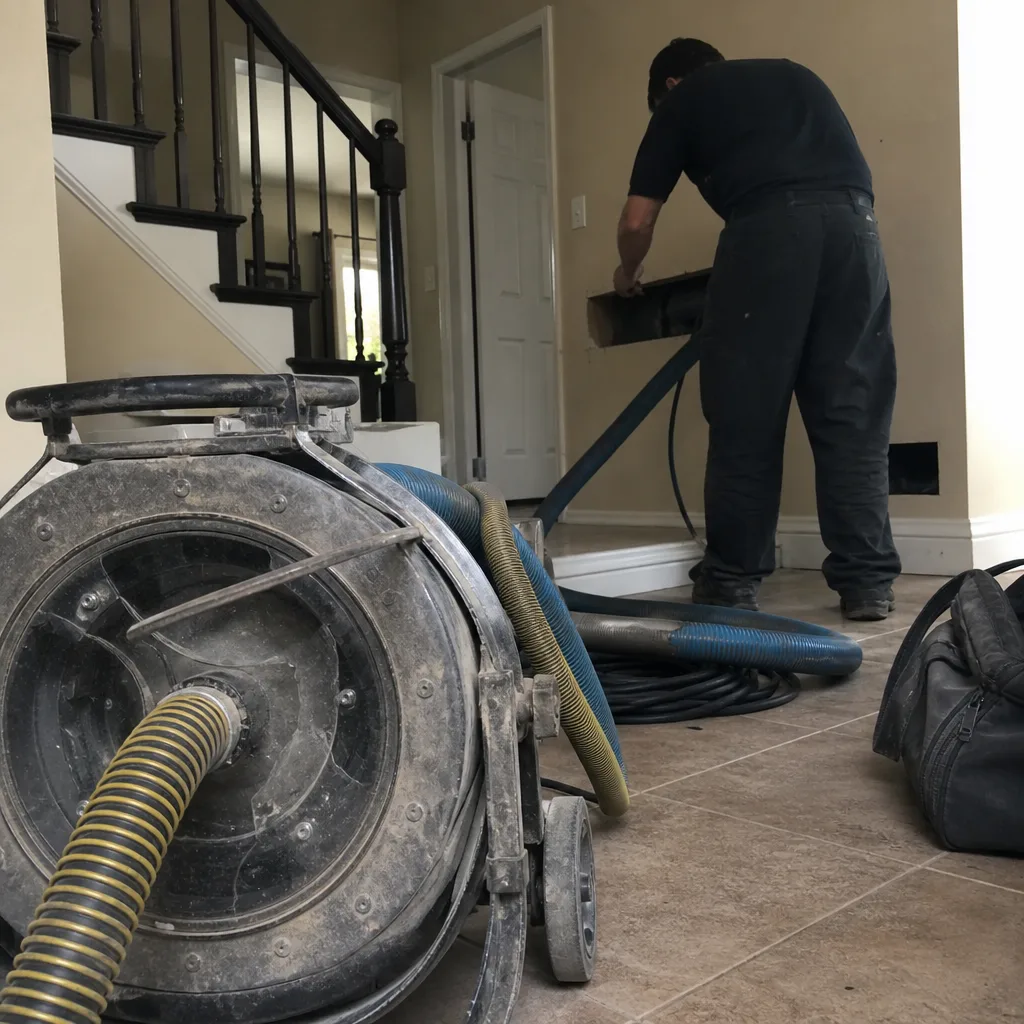 Before
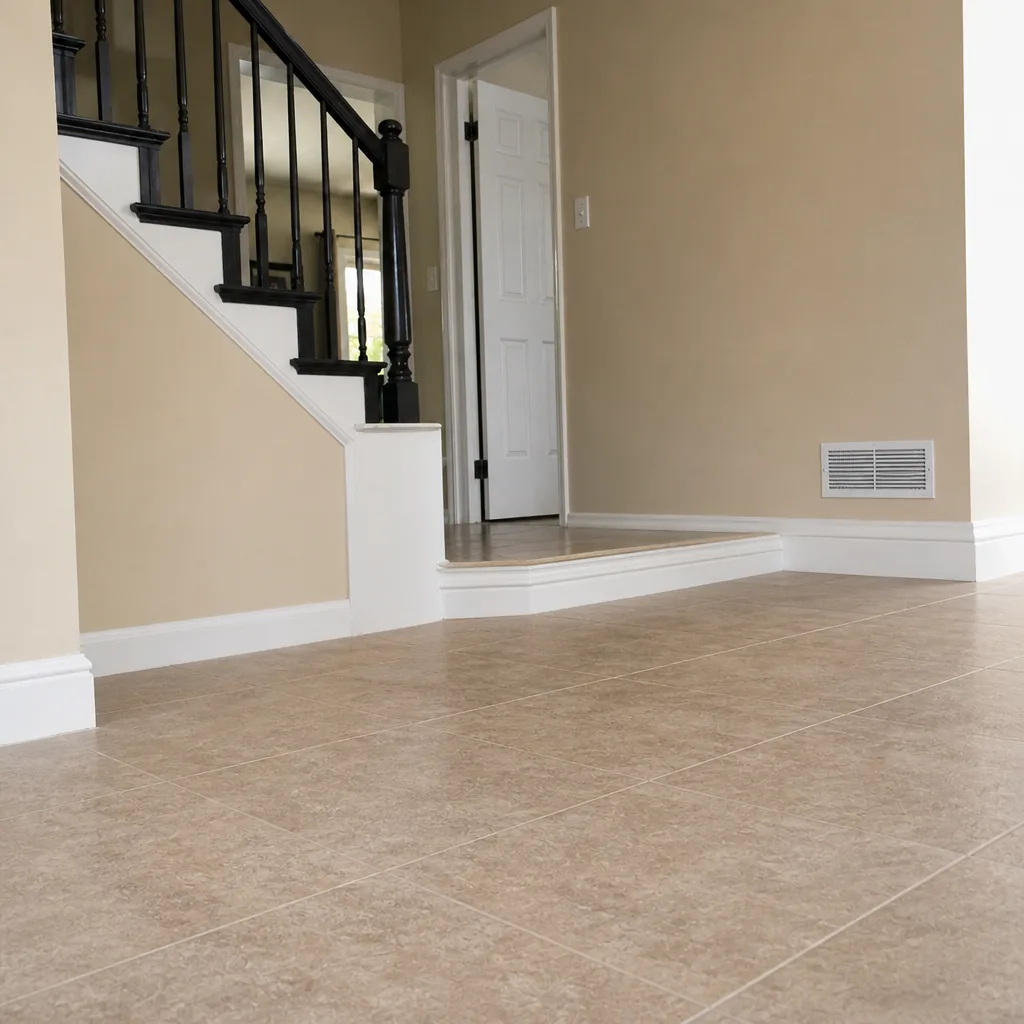 After
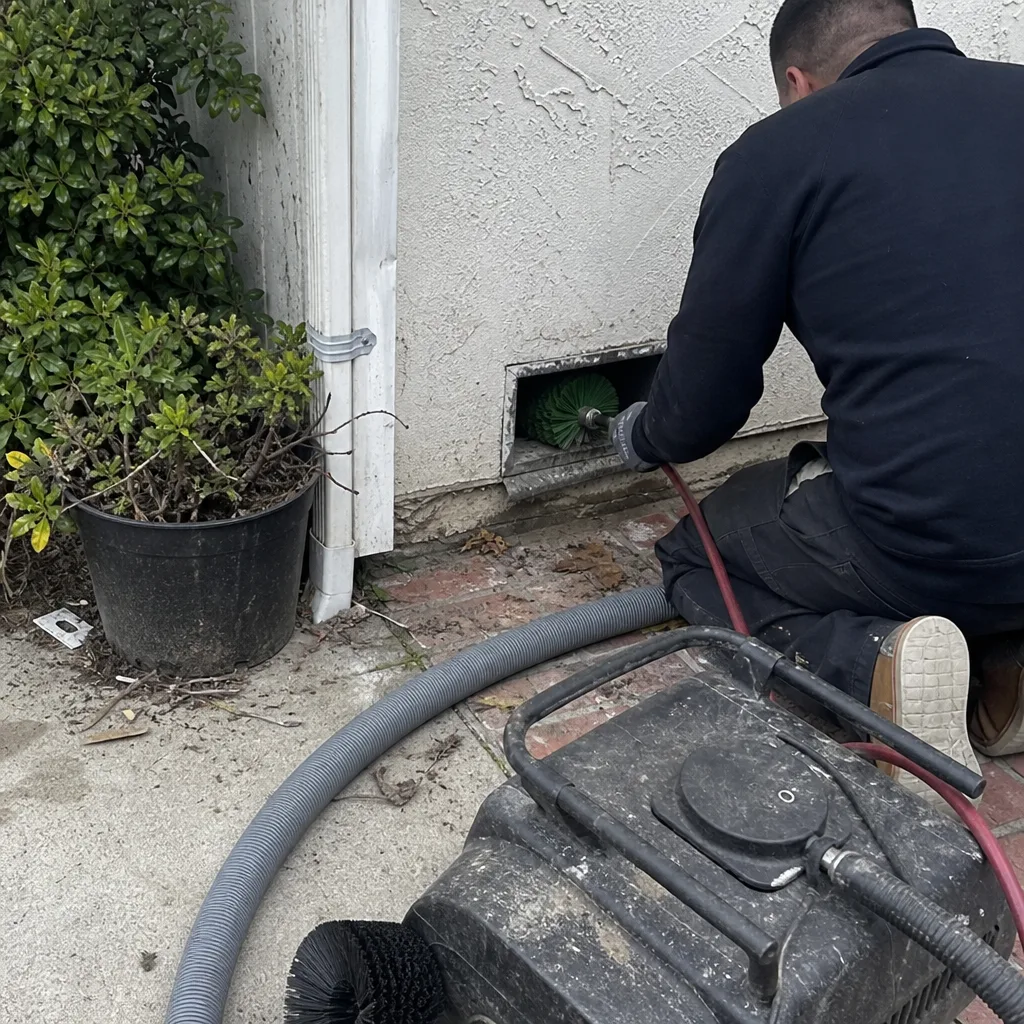 Before
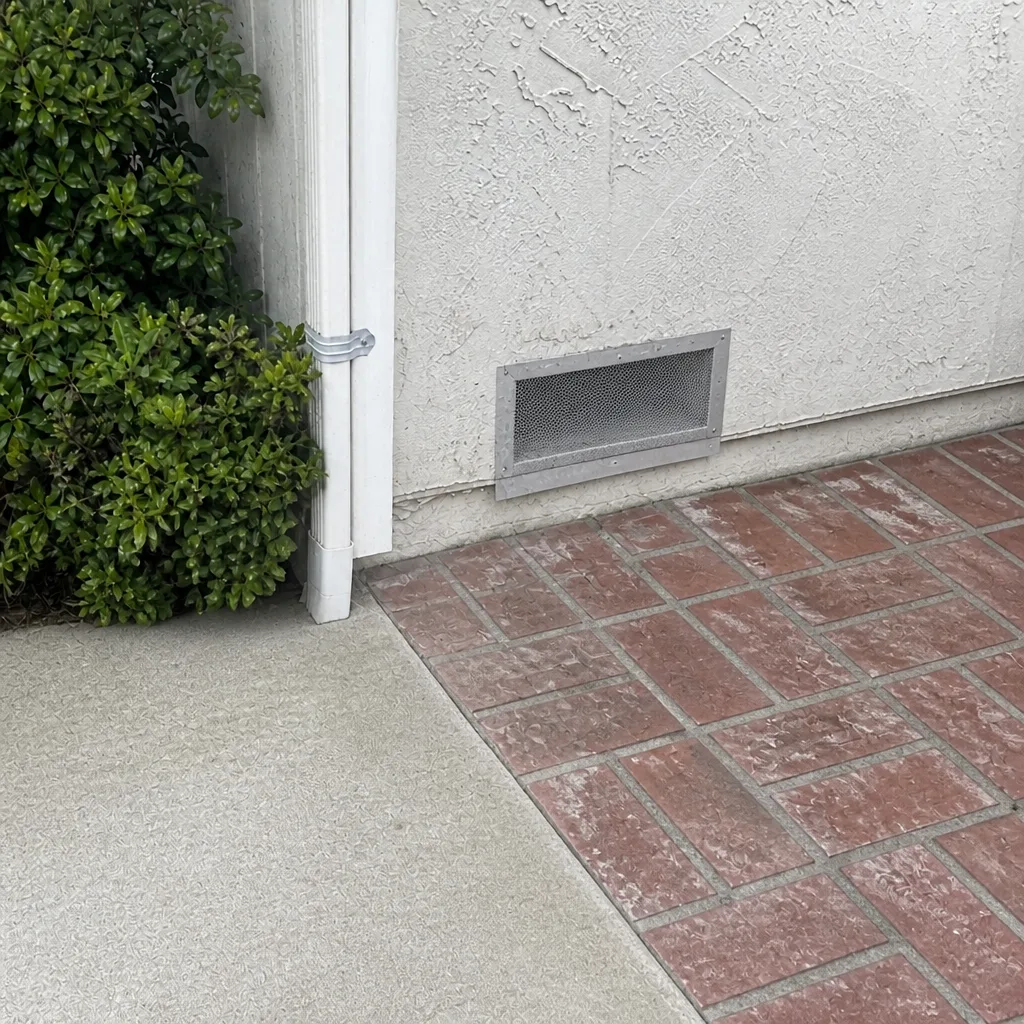 After
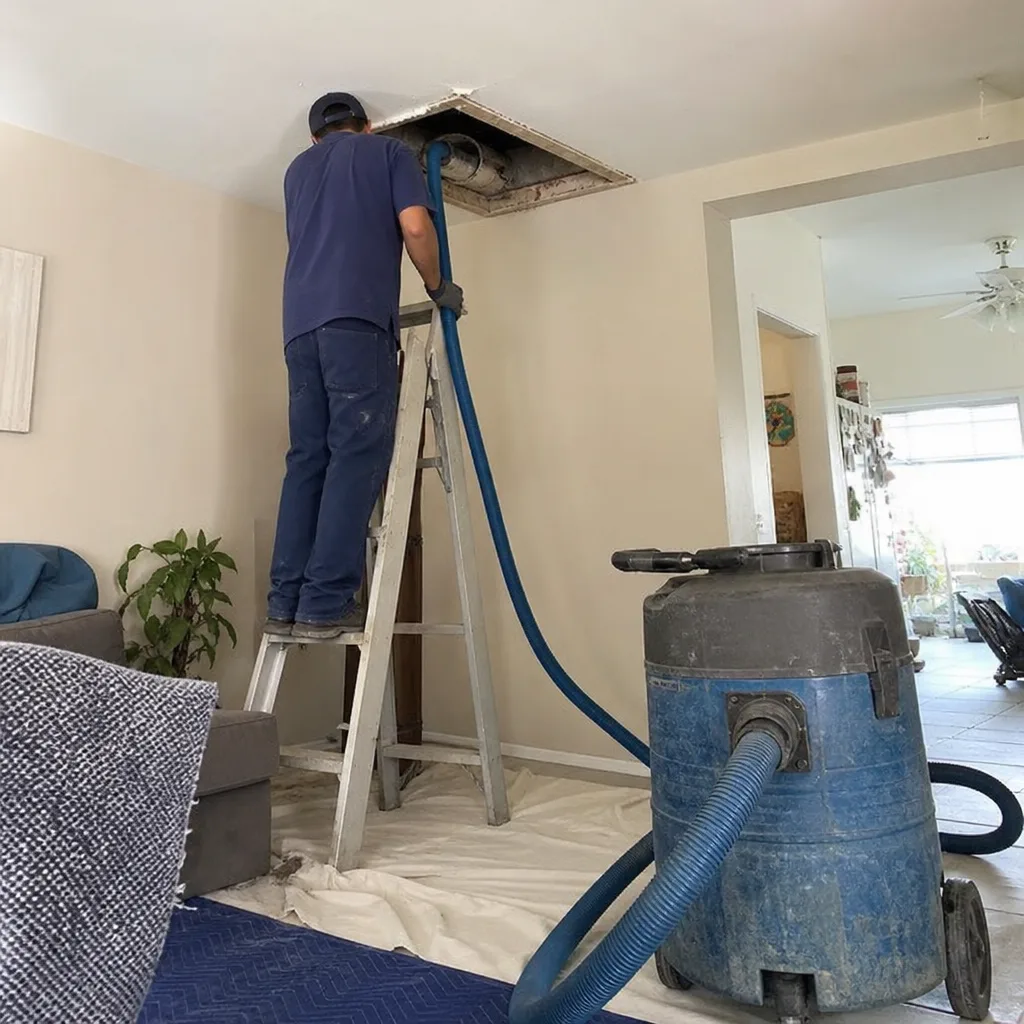 Before
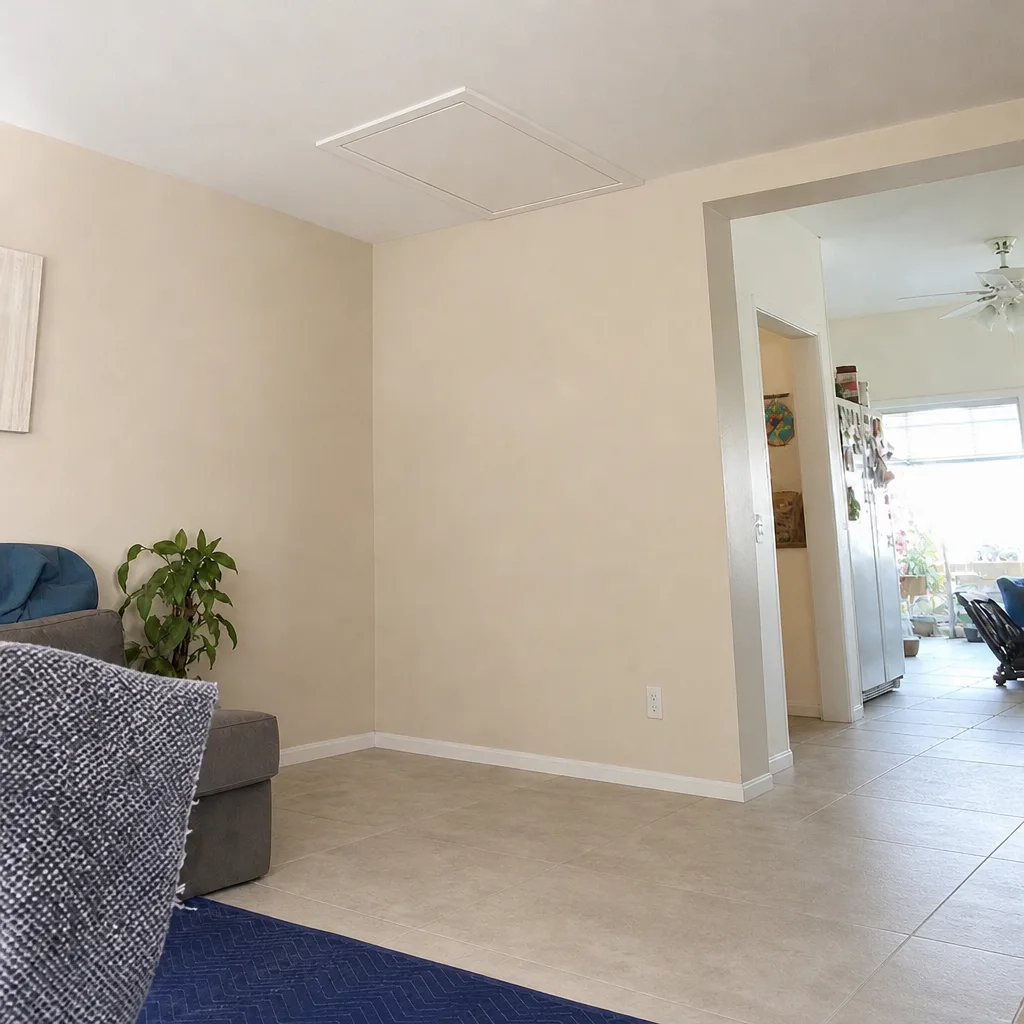 After
When to Call a Professional
Call a professional when the dust load is real and you need extraction rather than maintenance, when you find visible damage or liner disturbance during inspection, when the system hasn’t been cleaned in years, or when you want documentation of condition for a sale or a property record. Those cases call for professional-grade equipment and a flat per-system price agreed in writing before work starts. Huntington Beach Air Duct Cleaning Co offers free estimates in Huntington Beach and works with your insurer when remediation is part of the picture. Call (855) 658-4076. We answer 24/7. Fast dispatch from 7am to 7pm, Sunday through Friday.
Frequently Asked Questions
DIY is worth doing for surface maintenance only: filter changes, register grille cleaning, and lint removal at the accessible ends of the dryer vent. It’s not effective for cleaning inside duct runs because a shop-vac can’t generate the negative pressure needed to extract debris. Call (855) 658-4076 for an exact quote on professional cleaning. Estimates are free.
Air duct cleaning in Huntington Beach is priced per system, not per vent, and the exact cost is set by a written estimate after we look at your ductwork. That flat price covers the full system and is agreed before work starts. Call (855) 658-4076 for an exact quote. Estimates are free.
Cheap quotes are usually per-vent teaser prices that grow once the technician is on site, or they reflect plain consumer-grade equipment rather than professional machines. A shop-vac in a uniform isn’t duct cleaning. Call (855) 658-4076 for an exact quote and ask for the per-system price up front. Estimates are free.
Ask for before-and-after photos of your own ducts, not stock images. Professional equipment with HEPA collection also means you can see the debris removed from the system rather than recirculated into the room. We photograph every run cleaned. Call (855) 658-4076 for an exact quote. Estimates are free.
Most Huntington Beach homes need duct cleaning every several years, more often if you’ve had recent renovation, have pets, or someone in the house has allergies. Newer homes or recently cleaned systems can go longer with filter and register maintenance in between. Call (855) 658-4076 for an exact quote. Estimates are free.
Yes, particularly flex duct runs, which can be punctured or collapsed by a rigid wand or brush. Fiberglass-lined ducts are also vulnerable to liner disturbance that releases particles into the airstream. A professional cleaning uses tools matched to duct type to avoid both. Call (855) 658-4076 for an exact quote. Estimates are free.
The Bottom Line
DIY duct cleaning and professional cleaning work on different principles. A shop-vac lifts surface dust but can’t generate the negative pressure to extract debris from a full duct run; professional equipment can. In Huntington Beach, homes more than a few years old generally benefit from a professional cleaning priced per system with a written estimate, while newer systems can get by with filter and grille maintenance between professional visits. Dryer vents are the one area where DIY falls short on safety. If you want to know where your system stands, we’re happy to look.
Call (855) 658-4076 for a free estimate in Huntington Beach. We answer 24/7. Fast dispatch from 7am to 7pm, Sunday through Friday.
Written by the team at Huntington Beach Air Duct Cleaning Co.